|
Emergency in Haiti |
 |

HAITI EARTHQUAKE 17/03/2010: An extraordinary delivery of aid Faced with the need to provide one thousand people in the mountainous region of Mornes with temporary shelters this week, Handicap International benefited from an extraordinary form of logistical support - heavy helicopters.
As part of an operation to transport aid to more than one thousand people a few days ago, Handicap International used three high-tonnage helicopters and a team of a dozen people on the ground to transport 10 tonnes of equipment to an area inaccessible even to the six-wheel drive off-road trucks managed by the association. The focus of this operation – the isolated Mornes de Grand Goave area, to the west of Port-au-Prince - is located at an altitude of 1200 metres. Populated mainly by rural communities engaged in subsistence farming, the Mornes de Grand Goave were among the areas of the island most severely affected by the earthquake on 12 January and its aftershocks.
The area's traditional homes did not stand up to the earthquake and hundreds were totally destroyed. There were, however, a limited number of victims. This was due to the light structure of the “cailles”, as the local houses are known, and the fact that most of the inhabitants were working in the fields at the time of the disaster. The arrival of the rainy season in villages perched at high altitudes at the end of March meant that exceptional means had to be used to transport the shelters before the arrival of the violent tropical storms. A series of needs assessments performed jointly by Handicap International and Médecins du Monde enabled us to identify the priority sectors in a short space of time.
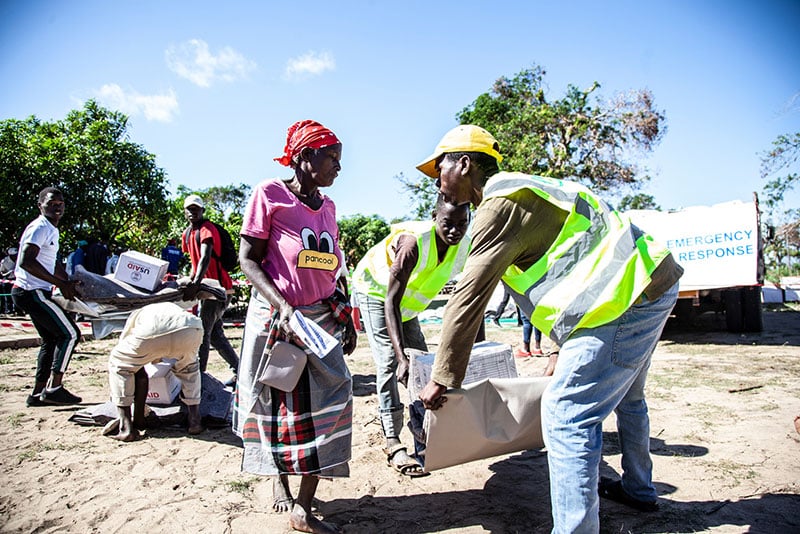
Winds of over 100 km/h In these steep, craggy areas accessible only by foot after long hours of walking, it was impossible to transport aid by convention means. That's why Handicap International, with the support of the United Nations and the World Food Programme (WFP), launched a shelter and non food items distribution programme by helicopter. The village of Béraud was the first to benefit from this project. On 2 and 3 March, more than one thousand people received shelters designed to resist winds of over 100 km an hour (“shelter boxes”) and plastic sheets. A ground team of around a dozen people and no fewer than three MI 8 helicopters, sometimes operating at their maximum capacity because of the unfavourable weather conditions in Béraud, were required to transport 10 tonnes of equipment. A second wave of deliveries is currently being prepared and is set to take place over the next few days. 
© O.Dorighel - Handicap International 24/02/2010: Earthquake emergency response - 2 new articles 1) Semi-temporary shelters built to last The people of Haiti urgently need shelters capable of resisting the coming hurricane season. The earthquake of 12th January left hundreds of thousands - perhaps even a million - people without shelter. The first storms of the rainy season have already begun and the most vulnerable people urgently need a roof over their heads. Handicap International has already distributed tents and shelter boxes (i) to one thousand families in the areas of Petit-Goâve and Mornes. The shelter boxes distributed by the association were supplied by the Rotary Club. They contain basic equipment for people who have lost everything. The next phase will consist of building scalable semi-temporary shelters. At least 200 will be built over the next few days. They will need to immediately stand up to the hurricane season, which starts in early August, and to last until a permanent home can be built. Covered with a sheet metal roof designed to resist gusts of wind, they will have a wooden base and a raised floor equipped with a ramp for easy access. For the sake of speed, the walls will initially be made from plastic sheets and woven mats. These temporary walls will then be replaced by more durable materials to create longer-lasting and more comfortable shelters. These shelters are small houses measuring around 20 sq. m., which the association will provide to the most vulnerable families. These families will help build these shelters to ensure they take ownership of them and are able to move them to another site if necessary. (i) Shelter boxes are small containers that are easy to transport and consist of a tent for 10 people, floor mats, blankets, a multi-fuel stove, cooking utensils, liquid containers, a water purification system, and tools including a saw, an axe, a spade, rope, mosquito nets, and even an activity pack for children.  © William Daniels for Handicap International 24/02/2010: Earthquake emergency response 2) “Most fractures have not healed normally” Géraldine Jacquemin manages Handicap International’s response teams in Haiti’s hospitals. There has been a lot of talk of amputees, but other traumas exist as well... A very large number of people have suffered fractures, particularly lower limb fractures. It is not possible to provide optimal case-management in an emergency, since many teams do not have radiology equipment, or materials to stabilise fractures or perform invasive surgery. They have little alternative but to reduce and stabilise fractures “in the dark”. We would usually perform a fracture reduction, that is, we put the bones back in place. Most of the radiographs we are doing now reveal fractures that have not healed in the normal way, and the bones are no longer aligned as they should be. It’s a major disabling factor: it can lead to deformed limbs, joint problems and legs of unequal length. It can also turn into a social disability because the people concerned will not be able to do the same activities as they did before the earthquake, if their work was physically demanding. Among the traumas you have encountered, what proportion are fractures? It is difficult to get an overall picture because patients are dispersed throughout the country’s hospitals. Over the last few days, our mobile teams, who perform out-reach work in various neighbourhoods, have met injured people who received care that was not adapted to their injury. However, in the hospitals in which we intervene, we estimate the number of fractures to be three times higher than amputations. It’s an orthopaedic disaster. How should people with orthopaedic injuries be case-managed? The first thing to do is to ensure the immediate case-management of patients, helping them to keep their joints flexible and to avoid contractures. This preventive work is necessary to ensure the patient’s condition does not deteriorate. When the plaster or external fixative is removed, it is important to get the patient mobile and moving their limbs again. If they can stand on one leg, we give them crutches and teach them how to move around with them. Is it possible to care for a poorly reduced fracture? If a fracture has not yet healed, we can intervene. Surgery is a possibility. But more than a month after the disaster, patients are still living in tents or in hospitals with poor hygiene conditions. This carries a major risk of infection. Using an internal fixative to unite a fracture is therefore not an ideal solution. If the fracture is not properly united, an even more complex surgical operation is required. Have you encountered other types of traumas? The earthquake caused a lot of neurological traumas. Walls fell on top of people, some of whom were pinned down under the debris and unable to move for several days. We have seen a huge number of neurological traumas resulting from fractures. We have also come across some very serious wounds. Our physiotherapists are working to avoid, once again, the development of contractures in injured limbs, and to reduce complications caused by prolonged immobilzation. What are conditions like for people with spinal cord injuries? We have recorded around 50 people with spinal cord injuries, spread over several facilities. But the day before yesterday, I met a paraplegic patient who was living in her own home, and who had not been registered. Most are paraplegic patients, with very few tetraplegic patients. It is therefore obvious that not everyone with spinal cord injuries is currently being case-managed. There may be others dispersed around smaller hospitals. Our goal is to register them and then, with our partners, to look for a solution to bring these patients together, supported by a long-term and specialised case-management plan. It’s a problem that Handicap International knows well, since it has already set up units for people with spinal injuries, particularly in Asia.  © William Daniels for Handicap International 08/02/2010: Building a new life with orthopaedic materials
Three weeks after a major earthquake hit Haiti, we are still focusing our response on providing emergency aid to those affected, and to amputees in particular, who now number more than 2000, according to our initial estimates. Handicap International is also preparing its long-term response to ensure the case-management of these thousands of victims. Isabelle Urseau, Handicap International’s rehabilitation manager, explains more in an interview. What mission are you performing in aid of amputees? Handicap International’s health teams in Haiti are currently performing the post-operative follow-up of people with injuries and amputees, with the aim of limiting disabling after-effects. The goal is to restore their independence, as far as possible, using adapted orthopaedic materials.
What are the conditions for getting a person back on their feet again? In order to fit an artificial limb onto an amputated limb, the amputation needs to have been performed under satisfactory conditions. The end of the severed bone needs to be rounded and covered with muscle padding. The amputation also needs to have been done a sufficient distance from joints to ensure the satisfactory functioning of the artificial limb.
And if these two conditions are not met? It is difficult if not impossible to fit an artificial limb. A second operation is necessary, representing an additional trauma for the amputee. In Haiti, it’s unfortunately a situation with which the members of Handicap International are familiar, because of the conditions in which a very large number of surgical operations have had to take place in record time. Certain amputations do not fulfil the conditions required to enable the person to be fitted with an artificial limb.
What are the different fitting stages? Amputees must be case-managed without delay. The first stage, following amputation, is the post-operative follow-up, which includes rehabilitation care to maintain muscular strength and joint flexibility, as well as psychological support. Handicap International is also setting up an amputee database to optimise the follow-up of patients over the long-term.
How quickly are you supplying artificial limbs? For this type of emergency, Handicap International is initially using a temporary fitting technology* that enables people to get back on their feet quickly and begin a more dynamic rehabilitation process, which is also favourable to their psychological state. These temporary artificial limbs can only be supplied after the stump has healed, that is, after several weeks or months. Such a fitting can then be performed within 24 to 48 hours. The patient rapidly regains their mobility, and therefore resumes physical activity favourable to their general state of health. Psychologically, a person’s self-image, sometimes seriously damaged by the loss of a limb, is to some extent restored. Their opportunities for the future are also considerably improved.
So emergency fitting is an intermediate stage? This approach will enable the rapid identification of people with painful stumps which require specific care and amputations in need of surgical correction. In this case, it is important that the operation takes place as soon as possible, since amputees are understandably increasingly reluctant to see their disabled limbs shortened again as time passes.
How long can the amputee keep these temporary artificial limbs? For four to six months. The stump gradually takes its definitive form and then enables the fitting of a permanent artificial limb, which is customized for the patient, and more aesthetic. Permanent artificial limbs must then be produced, which must be changed every three to five years in the case of an adult, and around every six months in the case of a child in full growth.
Are you planning to be involved over the long-term? Given the severity of the earthquake, the challenge which will arise in the very near future is the emergence of an “amputee generation” in need of artificial limbs. This task should be fulfilled by numerous stakeholders, as part of a coordinated and consistent approach. Handicap International is preparing to supply temporary emergency artificial limbs to three to four hundred people between March and August 2010. The association expects to start the production of permanent artificial limbs from July 2010 onwards. And we are planning to train Haitian staff to ensure the future follow-up of amputees in terms of fitting and rehabilitation. It’s a long-term challenge.
*Temporary artificial limbs (also called “training limbs”) are also used in care-management protocols in our countries. In a situation such as Haiti, they are called “emergency artificial limbs” because they enable us to respond to mass fitting requirements in a crisis situation within a very short space of time. 28/01/2010: 2,000 to 4,000 amputees according to Handicap International Faced by the sheer number of injured people, Handicap International’s health team in Haiti estimates the number of amputees could reach 2,000 to 4,000. Whilst continuing to provide emergency aid, Handicap International is already planning its long-term action. 29 expatriate staff and their 200 Haitian colleagues are taking part in our emergency response operation in Haiti, which includes caring for the injured, post-operative rehabilitation, the fitting of artificial limbs, and the distribution of humanitarian aid and temporary shelters. To care for the maximum number of injured people, Handicap International currently has around 30 staff split into six mobile healthcare teams. The healthcare team should reach around 100 people (of whom 30 are expatriates) in two to three weeks’ time. In Port-au-Prince, two of those teams, composed of rehabilitation specialists, are intervening directly in 8 hospitals, where only the most severe cases are taken in due to the massive influx of wounded people. The majority of operations are amputations. Some patients with closed fractures are having to leave without treatment, waiting until the most urgent cases have been attended to. Based on our work in these 8 hospitals, where more than 1,500 amputees have already been identified, and on data from other organisations, we estimate the number of amputees could reach 2,000 to 4,000. “The situation in Haiti today is really unprecedented” explains Thomas Calvot, specialist in the care management of earthquake victims at Handicap International. “This is due to the sheer number of the injured - 250,000 people according to the UN – and the destruction of health facilities. In emergency situations, doctors often have no other choice but to amputate. In the massive earthquakes in China in 2008 and Pakistan in 2005, the situation was less critical as hospitals were still working efficiently. In Haiti, no organisation is in a position to cover all the needs in this area. We are already working with partner organisations in order to take care of the maximum number of injured people, in a coordinated manner.” With the agreement of hospital managers, Handicap International’s teams are giving post-operative rehabilitation care, distributing walking aids and orthopaedic equipment and setting up a long-term follow-up system of these patients. “You must keep your joints moving”, Dr Colleen O’Connell repeats tirelessly to amputees, in overcrowded hospital wards. “You must do exercises every day to avoid muscular contraction. This is vital in order to fit you with an artificial limb later on.” The other four mobile units from Handicap International are working within four neighbourhoods in the capital (Carrefour, Carrefour Feuilles, Christ-Roi and Pétionville) to provide care and distribute walking aids in camps of homeless people and in smaller gatherings of people. Artificial limb fitting will be needed on a massive scale. This activity will only be able to start in March, once limbs have had sufficient time to heal following an amputation. Handicap International will produce between 300 and 400 emergency prostheses in the first six months. These temporary artificial limbs will then have to be replaced by final ones. Our aim is to create and coordinate a structure for rehabilitation and artificial limb fitting, building long-term capacity by training Haitian personnel to ensure the project’s sustainability. 22/01/2010: A long-term commitment Around twenty expatriate staff and their 130 Haitian colleagues are now involved in Handicap International's emergency response operation in Haiti, which includes caring for the injured, post-operative rehabilitation, the fitting of artificial limbs, and the distribution of humanitarian aid and temporary shelters. These actions, which were launched by Handicap International in the days immediately following the earthquake of 12 January, will be extended over the long-term, with a continued focus on the most vulnerable populations, including its temporary shelter programme. Health Six mobile care teams have been working in four neighbourhoods of Port-au-Prince since Monday, providing first aid and stabilising the condition of the injured before they are able to access hospital care. They are supported by five rehabilitation specialists from Canada and the US. In addition, two physiotherapists from Handicap International , who arrived on Wednesday evening, are working in partnership with MSF. Handicap International is therefore in a position to intensify its efforts in hospitals and to identify and record injured persons within communities, with the aim of ensuring they receive the necessary care on-site or to monitor their progress once they have been taken to hospital. Our post-operative follow-up care and emergency rehabilitation actions will also be scaled-up.
Hundreds of amputations are currently being performed in Haiti. Handicap International's goal is to start fitting preliminary artificial limbs from next March, leaving time for amputations to heal, with the aim of producing 300 to 400 emergency artificial limbs over the next three months. Before the earthquake, there were virtually no rehabilitation and fitting professionals in Haiti, which has heightened the importance of our work. Logistics support Two days after the earthquake, Handicap International was able to organise its first humanitarian aid convoy from the city of Gonaïves to Port-au-Prince. The redeployment of the fleet of 45 lorries managed by the association* has ensured a constant turnover of vehicles, helping reduce congestion at the airport, where most humanitarian aid is arriving. Handicap International also has an operational 3,500 sq.m. warehouse where it stores a proportion of this aid before it is sent out to secondary distribution points. This support mission, which benefits the entire humanitarian community in Port-au-Prince and the rest of the country, will continue for several months as required by the scale of current needs. Temporary shelter Handicap International will also intervene to the west of Port-au-Prince, primarily in the regions of Petit-Goâve and Grand-Goâve. Located around ten kilometres from the epicentre of the earthquake, these two areas were destroyed to an extent of 60%, with 50,000 people affected in these regions alone. The association is preparing to distribute emergency kits containing sheets and rope, to provide the affected population with shelter, along with blankets, mats, water filters, jerrycans and cooking utensils. This represents practical and essential aid for those most severely affected. * Handicap International has been managing a fleet of 45 off-road lorries since the end of 2008 in Haiti, in partnership with the World Food Programme. 21/01/2010 - Listen to Stephanie Stuart, Director of Handicap International UK on BBC Radio discussing the situation of amputees in Haiti and their long term rehabilitation needs. BBC Radio 5 live, 5.40pm Click here to listen to the programme again on BBC iPlayer or go to http://www.bbc.co.uk/5live 20/01/2010: Handicap International's emergency response team intensifies its efforts following the strong aftershock this morning Whilst tens of thousands injured people are still unable to access healthcare and following the strong aftershock this morning, Handicap International’s team has already found hundreds of people having had or about to have an amputation. Handicap International is appealing for donations to support the immediate and long-term needs in artificial limb fitting and rehabilitation. A week after the earthquake, only 12 hospitals in Port-au-Prince are operational and they are overwhelmed. The United Nations estimated on Monday 18th January that 250,000 people have been injured in the disaster. Hospitals are trying to try to save as many lives as possible by ensuring the quick turnaround of patients. However, the consequences of this could be extremely serious, both for people reaching the hospital too late and for those leaving too early. In these conditions, reminiscent of a war zone, people having received care or having had an operation are being discharged from hospital without advice on treatment, without post-operative follow-up and without any prospect for rehabilitation. They are returning to the streets or to make-shift shelters that have sprung up everywhere. Hygiene conditions are terrible, making the risk of infections and gangrene very high. Since Saturday, Handicap International has registered over 400 amputations that have taken place in the capital alone. Some of our emergency specialists, on their way from the US and Canada and on a quick transit through Saint Dominigua, found around 20 Haitian amputees in the Dominican capital. Sadly the number of amputees is expected to increase rapidly in all places where the injured are receiving treatment. For the moment, no data is available on the number of people paralysed following spinal injuries. “It is vital that amputees and patients with other injuries are followed up immediately after their amputation or surgery in order to avoid further complications or permanently disabling after-effects”, explains Thomas Calvot, specialist in the care management of earthquake victims at Handicap International. “This is the cornerstone of Handicap International’s activities during an emergency.” Handicap International now has 6 mobile teams providing first aid treatment and stabilising patients while they wait to get to hospitals. A rehabilitation expert, two prosthetics and orthotics technicians, an occupational therapist and a physiotherapist arrived today and more staff are on their way. Post-operative care and rehabilitation activities will be starting this week. The first artificial limb fittings should start in 6 weeks, enough time for the limb to heal after an amputation. These rehabilitation activities will have to continue for several years to support the huge number of injured people in Haiti. 18/01/2010: Caring for the wounded and distributing emergency aid Despite a very chaotic environment in Port-au-Prince, Handicap International began delivering humanitarian aid on Thursday 14th Jan. Since Saturday 16th, we have also been providing emergency care to the wounded. Our team has already identified more than 150 people having suffered amputations, and sadly hundreds more are planned. An operational logistics platform The 45 trucks that Handicap International had been managing as part of a partnership with the World Food Program (WFP) started deliveries 2 days after the disaster. By Thursday, the first two convoys brought 1,200 litres of water and four tons of energy biscuits from Gonaives (north of Haiti) to Port-au-Prince *. Friday morning, eight more trucks were leaving for the Haitian capital with fuel and water treatment equipment for Action against Hunger. The transport will now be organized regularly for the delivery of priority goods (water, food, medicines) under escort, and under the coordination of the UN. Several logistics experts, flown over from France, Cote d'Ivoire and French Guiana have arrived, or are en route to Haiti. They supplement the system already set up to ensure the reorientation of the logistics platform and distribution of aid. One of these people will do an assessment tomorrow in Leogane, west of Port-au-Prince, as 80 to 90% of the town was destroyed according to the UN. The aim is to assess the needs, especially in temporary shelters. Care for the wounded and amputees By Saturday, we started providing care to injured people. From Tuesday 19th Jan, thanks to the recruitment of a dozen Haitian health workers, our support will be extended to 6 hospitals and 4 of Port-au-Prince's poorest districts (including Carrefour and Carrefour Feuille), where most of the population is. An initial assessment has identified more than 150 amputees, numbers necessarily incomplete, since many people have not been able to visit hospitals. The needs for rehabilitation appliances will be massive. Further reinforcements are expected in the middle of the week from the United States and Canada. Five additional people - a rehabilitation expert, two orthopaedic experts, one occupational therapist and a physiotherapist - will work on the care given to the wounded. Meanwhile, two physiotherapists sent by our Belgian offices are leaving today for Haiti. During the next two months they will work with teams from Medecins Sans Frontieres , to ensure the care of post-operative rehabilitation for those injured (multiple trauma, fractures, amputations, spinal and neurological lesions). Distribution to Hospitals Seven pallets of equipment consisting of crutches, canes, walkers, prostheses and wheelchairs left on Thursday and will be delivered to hospitals today. Another cargo of 1.5 tonne left in the early hours this morning. Precarious situation Despite significant communication difficulties due to destruction of infrastructure, our organisation started its activities immediately. The team works in very precarious conditions, the house in which lived the expatriate staff is destroyed, and the offices are no longer usable, weakened by the earthquake. After nine of our Haitian drivers were found safe and sound, the remaining 22 team members based in Port-au-Prince have been located in good health. The team of Jacmel, 100 km south of the capital, are also safe. * Handicap International was present in Haiti for over a year, following the four hurricanes that struck the island between August and September.
15/01/2010: Two initial aid convoys sent to Port-au-Prince Handicap International sent its first two convoys Thursday morning, thanks to the fleet of off-road trucks the organisation manages in partnership with the World Food Program (WFP). The convoy left Gonaives, in the north of Haiti, for Port-au-Prince at 8 am, with a WFP consignment consisting of 1,200 liters of water and four tons of energy biscuits. The second convoy of eight trucks will leave Friday at 4 am to transport water treatment equipment for Action Against Hunger, and they are expected to reach the outskirts of the capital by 8 am. “Unfortunately, for the moment, we do not have any medication or temporary shelters to transport, but it's a good start” said Daniel Chebbahi, Handicap International's operational base coordinator in Gonaives. For security reasons, these convoys need to be escorted by soldiers from Minustah (U.N. Stabilization Mission in Haiti), which requires coordination, and therefore time, under the current circumstances. Large numbers of injured fleeing Port-au-Prince “Since the day after the earthquake, we have noticed that a growing number of injured people have been fleeing Port-au-Prince, where they are unable to receive care, and heading for the north of the country by all possible means, sometimes even on foot,” Chebbahi said. He spoke of a young woman with a broken leg who arrived on a motorcycle taxi Wednesday after a 160 km journey between Gonaives and the capital. “More and more vehicles are hitting the roads and a bus collection system is beginning to take shape. People are travelling along the road and stopping for treatment, more or less successfully.” In Saint-Marc, halfway between Port-au-Prince and Gonaives, a small hospital with 100 beds has already taken in more than 200 people. The three hospitals in Gonaives are already saturated too, Chebbahi reported. “People have crushed limbs, frequently infected cuts, and sometimes multiple or open fractures. They need orthopedic care but there are very few specialist doctors on hand to help them and almost no suitable equipment." Chebbahi said that for the rest of the population, the situation remains highly unstable. The electricity supply was restored Thursday, but in Haiti, it has never been great. Those who were able to do so installed generators. Oil supplies will soon be running low. The security situation seems to be worsening, he said. “I have heard people talking about the first outbreaks of violence in central Gonaives. There are stories going around that prisoners who escaped from the central prison in Port-au-Prince after the earthquake may have returned to their region of origin, to Raboto and Gonaives, where they are now reported to be creating havoc.”
14/01/2010: Emergency in Haiti - Action following the earthquake Handicap International is taking action to provide emergency aid following the violent earthquake which hit Haiti on January 12th. The team currently in place in Haiti will be strengthened as of tomorrow to respond to this unprecedented natural disaster which has destroyed large numbers of buildings in the capital Port-au-Prince. Tens of thousands of people are feared dead, and many thousands more are buried in rubble. Countless people are now homeless. Electricity and telephone lines have been cut. Medicines, food and water are in short supply. It was one o'clock in the morning in Lyon when Handicap International's Head of Mission in Port-au-Prince contacted Hélène, our Head Office Emergency Programmes Manager, by satellite phone. He described a catastrophic situation with destroyed buildings, burning petrol stations and looted shops. The lines of communication were all down and it was impossible to get around by any other means than on foot. The house in Port-au-Prince which accommodated Handicap International's staff has been destroyed by the earthquake and at this point in time we do not know whether any of our Haitian colleagues are among the victims. The intial assessment of the situation is alarming. Hospitals and other public buildings have been completely destroyed and the number of victims is likely to run into the hundreds or even the thousands. The earthquake, measuring 7.3 on the Richter scale, hit the country on Tuesday at 5 pm local time, with the capital Port au Prince and its two million inhabitants the worst affected. Handicap International has been working in the country for over a year, following the hurricanes which hit in the summer of 2008. Since the end of 2008 Handicap International, in partnership with the World Food Program (WFP), has managed a fleet of 45 all-purpose lorries used to distribute humanitarian aid to areas to which access is severely limited. As soon as the disaster hit, our team in Haiti took immediate action to launch emergency rescue operations. Back up for the Handicap International team currently in place will arrive today and funds have been released to help the injured as rapidly as possible. This emergency team will join the five expatriate staff members already working in Haiti. The team of physiotherapists and logisticians will help us provide support for the victims of the earthquake which hit the island on Tuesday evening. By the end of the week one tonne of equipment (wheelchairs, orthoses, walkers, crutches etc.) will be sent out, with the first plane shipment leaving Lyon today. It is likely that Handicap International will face numerous difficulties including a lack of operational health structures due to the destruction of buildings, a lack of available qualified personnel and a complex security situation which was already critical prior to the earthquake. Haiti, one of the poorest countries in the world, is regularly affected by natural disasters and has suffered from decades of political instability.
|